



-
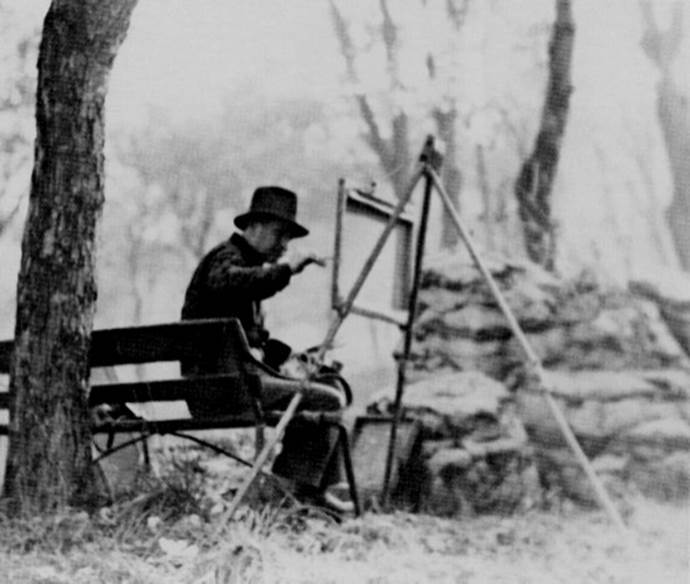
Borenstein painting on Mount Royal, 1948.Photo Credit : Tansky’s Phone Booth -
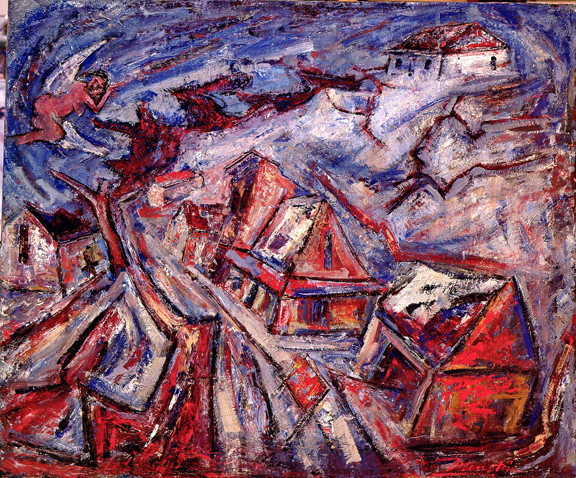
Sam Borenstein, Composition in red and blue, 1944, oil on canvas, 107x72 cm.Photo Credit : © Borenstein Estate -
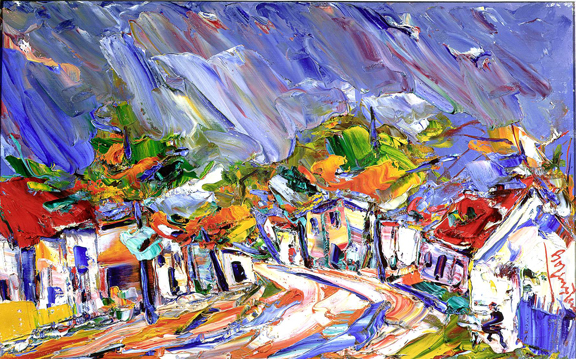
Sam Borenstein, Ste. rose quebec, 1956, oil on canvas, 51x81 cm.Photo Credit : © Borenstein Estate -
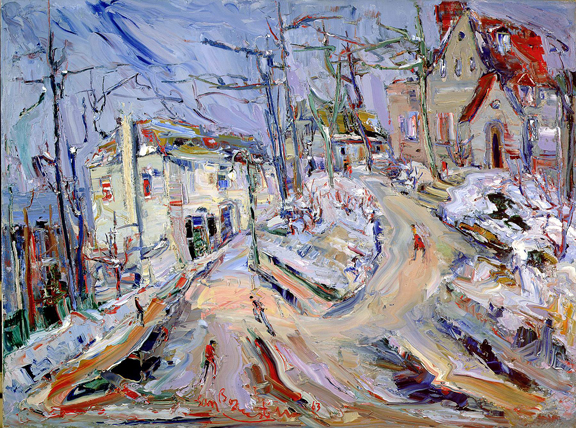
Sam Borenstein, Streetscene in Westmount, 1963, oil on canvas, 76x102 cm.Photo Credit : © Borenstein Estate
Sam Borenstein
Sam Borenstein, one of the Jewish Painters of Montreal, was a renowned Canadian artist.
Born in Lithuania, Borenstein immigrated to Montreal in 1921 with his father and one sister. He first worked as a furrier’s apprentice in Ottawa before returning to Montreal, where he found employment in the garment industry. He took evening classes in drawing and sculpture.
Borenstein’s expressionist style was inspired by masters such as Chaim Soutine and Vincent Van Gogh. He began exhibiting in Montreal in 1934. His first subject was Depression-era Montreal, which he depicted with great energy and bright colours. In 1939, he travelled to Brittany, and was able to see the works of his mentors. From that point on, his painting became more focused. In the 1940s, he travelled to the Laurentian Mountains, where he painted many of his most well-known works. Although acclaimed for his colourful landscapes, full of movement and energy, Borenstein also painted portraits.
Since the 1960s, many of his works have been shown at the Galerie L’Art français. In 2005, he was the subject of an exhibit at the Montreal Museum of Fine Arts. In 1992, he was the subject of a documentary directed by his daughter, called The Colours of My Father.
Learn more:
https://en.wikipedia.org/wiki/Sam_Borenstein
http://www.klinkhoff.ca/artist-sam-borenstein-paintings
http://www.gallery.ca/cybermuse/enthusiast/thirties/artist_e.jsp?iartistid=601
-
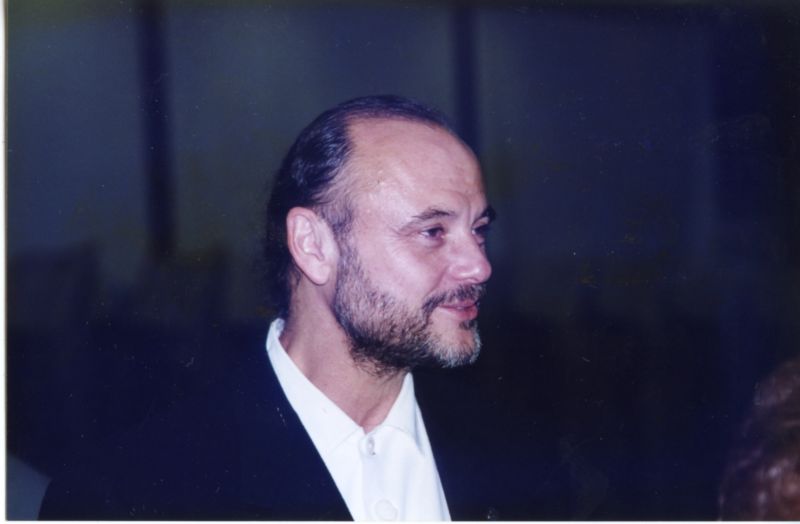
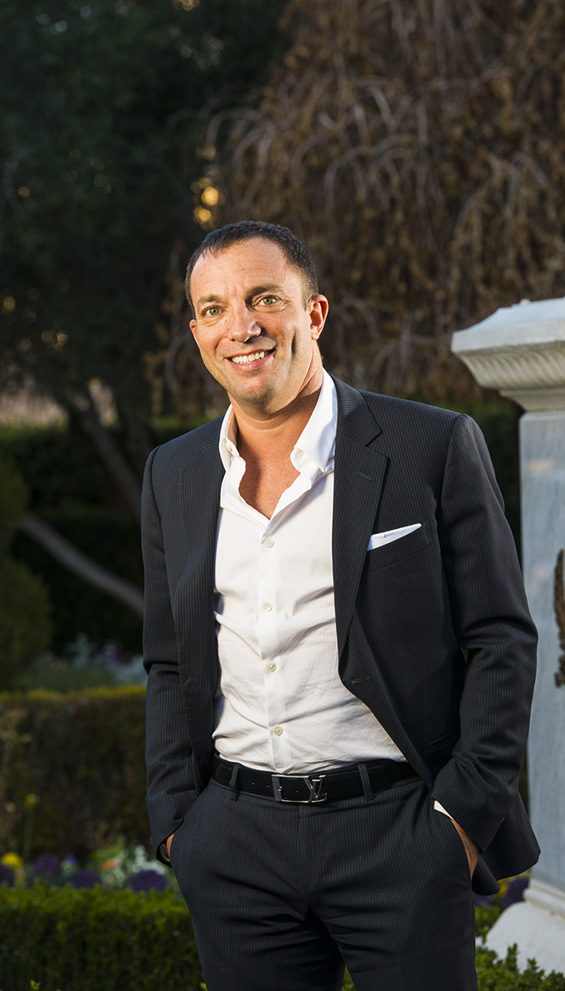
Ian Greenberg, one of the four brothers who founded Astral Media Inc.Photo Credit : The Canadian Press -
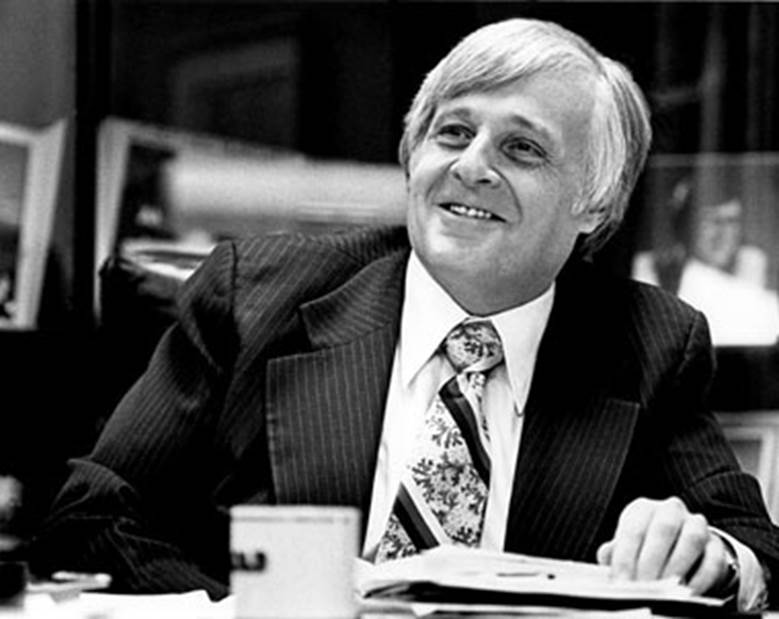
Harold Greenberg, Canadian Film Producer, Former Chairman of the Board, Astral Communications, (1980).Photo Credit : The Canadian Encyclopedia -
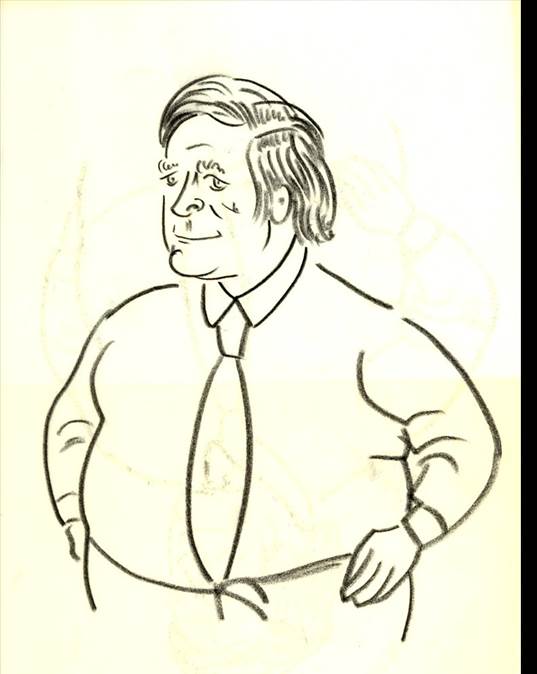
Sketch of Harold Greenberg by Louis Seligson.Photo Credit : Alex Dworkin Canadian Jewish Archives
The Greenberg Family
Harold Greenberg and his three brothers – Harvey, Sidney and Ian – were the co-founders of Astral Media, Inc., one of Canada’s largest independent Media companies, which had its hand in photography, film, TV, radio and music.
The brothers, born into an Ashkenazi Jewish family, grew up in Montreal, around the Main and Côte Saint-Luc neighbourhoods. Their first joint venture was Angreen Photo Inc., a photo company which they founded in 1961. Then, in 1963, they acquired the Bellevue Pathe photo finishing labs. Their big break came with Expo 67, when Angreen was granted exclusive rights to sell films, cameras and photographic materials.
With their newfound fortune, Angreen was able to acquire Astral Communications, which would go on to become Astral Media, and own the largest group of radio stations in Canada, not to mention premium and specialty TV channels. The Greenberg brothers were the biggest shareholders, and Harold took on the role of President and CEO. In this position, he pushed the company to develop videocassette production, post-production and film distribution. He was an adamant supporter of using Quebecois, instead of Parisian, French subtitles for film and TV in the province. Towards the end of his career, he was expanding into new media, like CD-ROM and computer animation. Harold also made a name for himself in the movies, working as an executive producer on feature films including Porky’s, Breaking Point and The Neptune Factor.
Astral created The Harold Greenberg FUND (Foundation to Underwrite New Drama) to honour Harold’s support of Canadian programming, and over the next 20 years, the FUND invested over $50,000,000 in Canadian productions. In recognition of his community involvement, Harold was also made an Officer of the Order of Canada, Knight of the Legion of Honour, and a Knight of the National Order of Quebec.
In 1996, following Harold’s death, Ian assumed control of the company. It gradually transitioned into a pure-play media company, focused on television, radio, advertising and digital media properties. Before the company was acquired by Bell Canada in 2012, Astral Media boasted over 2,800 employees, in eight Canadian provinces, and operated 84 radio stations and 24 pay and specialty television channels.
Learn more:
https://en.wikipedia.org/wiki/Harold_Greenberg
http://www.theglobeandmail.com/globe-investor/a-bittersweet-day-for-ian-greenberg/article4202832/
-
Moses Znaimer, 1977.Photo Credit : Jewish Public Library - Archives -
MusiquePlus, a popular music-television station in Quebec, was founded by Znaimer in 1986.Photo Credit : Musiqueplus
Moses Znaimer
Moses Znaimer is a Canadian media mogul and current head of ZoomerMedia who, amongst other ventures, founded both the MuchMusic and MusiquePlus television channels.
Born in Tajikstan to Latvian and Polish refugees of World War Two, Znaimer arrived in Montreal in 1948 after a stay in a Displaced Persons Camp in Germany. He graduated from McGill University with a BA in Philosophy and Politics and from Harvard University with an MA in Government. While at McGill, he served as President of the McGill Debating Union.
Znaimer’s career in broadcasting began when he joined the Canadian Broadcasting Corporation (CBC) in the mid-1960s. Known for such shows as Cross Country Checkup, as well as Take 30 with Adrienne Clarkson, Znaimer left CBC and entered into private broadcasting.
In 1972, Znaimer and a partner launched Citytv, pioneering a casual and contemporary broadcasting style aimed at youth. In 1981, Toronto-based media conglomerate CHUM Limited purchased Citytv, and Znaimer became Vice President of CHUM and Executive Producer for all of Citytv’s programming. By 1984, Znaimer and John Martin’s vision of a 24-hour music video station was realized with the creation of MuchMusic. MusiquePlus, a joint venture based in Montreal and catering to Canada’s French-speaking audiences, was launched in 1986. Znaimer’s company also launched channels such as Bravo! (1995), Space (1997), the first 24-hour local news station, CablePulse 24 (1998), Canadian Learning Television, Star!, Drive-In Classics, Fashion Television, BookTelevision, CourtTV Canada, SexTV: The Channel, MuchLOUD and MuchVibe. Although he resigned in 2003, he reappeared in 2005 and created a new media empire, ZoomerMedia.
Znaimer’s contributions to Canadian culture have been recognized with a Governor General’s Performing Arts Award for Lifetime Artistic Achievement and the Order of Ontario.
Learn more:
https://en.wikipedia.org/wiki/Moses_Znaimer
http://www.mosesznaimer.com/
http://www.huffingtonpost.ca/2015/10/18/moses-znaimer-elder-care-canada_n_8314574.html
http://www.blogto.com/city/2012/09/that_time_when_citytv_was_the_street/
https://www.youtube.com/watch?v=WKvs5fyRKu4
https://www.youtube.com/watch?v=jFqQcbV-3e0
Mitch Garber
Born and raised in Montreal, Mitch Garber began his professional career as a lawyer but moved on to a diverse and storied career in business, ultimately becoming one of the most influential powerbrokers in the gaming, entertainment and hotel industries.
Garber’s first major position was as CEO of PartyGaming, one of the world’s largest online gaming companies at the time, and then, in 2009, as head of Caesars Interactive Entertainment, the newly formed digital gaming and entertainment division of Caesars Entertainment, and since 2013 CEO of Caesars Acquisition Company, owner of the World Series of Poker and six hotels and casinos in Las Vegas , New Orleans and Baltimore.
Mitch is well-known in Quebec for his cross-cultural role on Dans l’oeil du dragon, the French-Canadian equivalent of CBC’s Dragon’s Den, as its first ever Anglophone judge. In 2015, he participated in the TPG led buyout of Cirque du Soleil and became its Chairman.
Speaking to reporter Sandie Renaldo, as part of a feature story on the TV newsmagazine W5, he expressed pride in calling Montreal home, despite living in many other cities around the world: “I wanted my kids to have the same Canadian feeling, the same Quebec upbringing and education that I had and my wife [Anne-Marie Boucher] had.” He is known to be a staunch advocate for bilingualism, urging fellow Anglophone Quebecers to avoid cultural insularity.
Committed to giving back philanthropically, he recently co-chaired Montreal’s annual Centraide campaign, serves on the Board of the One Drop Foundation, and established The Garber Family Post Doctorate Fellowship in Hereditary Cancer at McGill’s Faculty of Medicine, in addition to raising funds for Cystic Fibrosis research with Celine Dion and the late René Angelil, and several other charitable involvements.
-
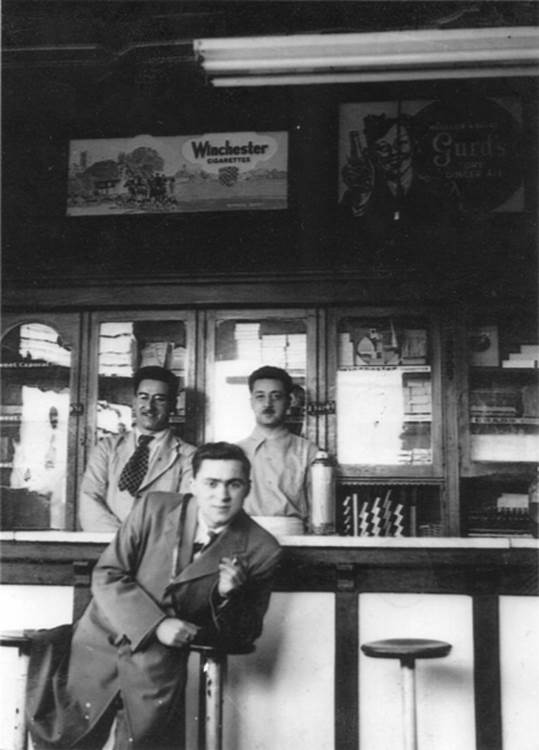
Moe Wilensky on right. His brother Archie on left. With customer, ca. 1932.Photo Credit : The Wilensky family -
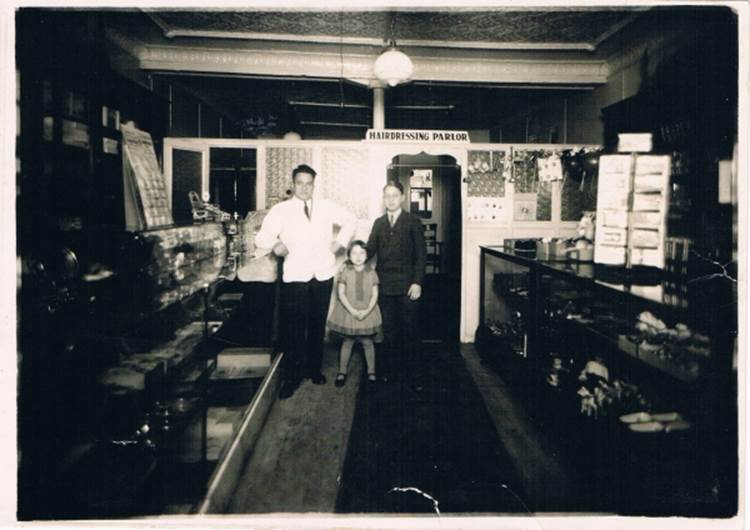
Harry, father, with Moe and Sylvia Wilensky in Harry's tobacco and barber shop at 4159 St. Laurent ca. mid 1920s.Photo Credit : The Wilensky family -
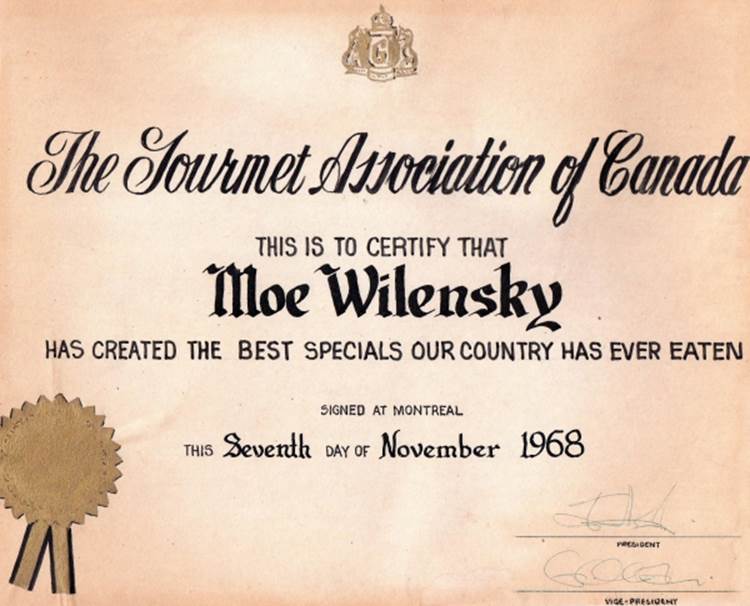
The Gourmet Association of Canada Certificate, 1968.Photo Credit : The Wilensky family -
Moe Wilensky with second son Bernard in 1972.Photo Credit : The Wilensky family -
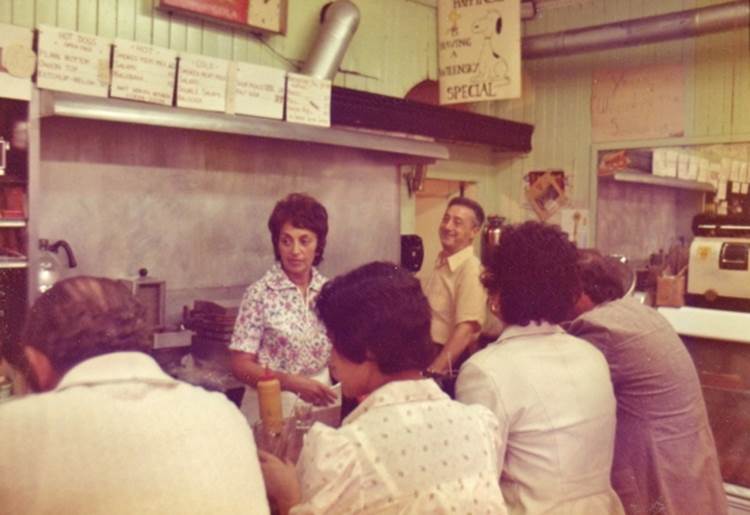
Ruth and Moe Wilensky in the mid-1970s.Photo Credit : The Wilensky family.
Wilensky’s Light Lunch
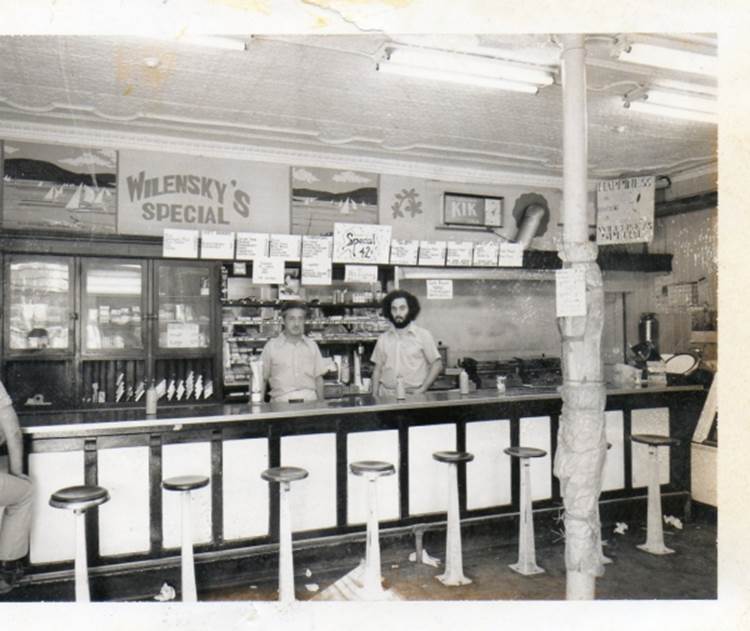
Founded by Moe Wilensky in 1932, Wilensky’s Light Lunch is one of the last bastions of Eastern European Jewish culture in the Mile End – a restaurant famous for its “Wilensky’s Special,” a fried salami and bologna sandwich served with mustard on a pressed roll.
Harry Wilensky, Moe’s father, emigrated from Russia to Montreal around the turn of the 20th century, along with many other Eastern European Jews. Wilensky opened a small barbershop and variety store that relocated several times following the “downtowner” Jewish community as it moved north along the Main. Harry’s sons Moe and Archie joined the family business and Moe convinced his father to start selling sandwiches.
The shop moved to 119 Fairmount O. in 1932, to the corner of Fairmount and St-Urbain in 1935, and to its present location, at the corner of Fairmount and Clark, in 1952. Not much has changed since then, not even the food or the decor.
Wilensky’s was immortalized by Mordecai Richler, a regular at the diner when he was young, as Moe’s Cigar Store in The Apprenticeship of Duddy Kravitz. Several scenes for the novel’s film adaptation were also shot on site at Wilensky’s.
The restaurant is a Jewish Montreal landmark, evoking a time when the city’s immigrant Jewish population lived mostly in the Mile End, subsisting thanks to countless small businesses such as Moe Wilensky’s. In the early 20th century, Mile End eateries also provided many Montrealers with their first exposure to Jewish culture.
Special thanks to the Museum of Jewish Montreal.
Learn more:
http://imjm.ca/location/1471
http://blogs.villagevoice.com/forkintheroad/2010/11/wilenskys_light.php
http://www.cbc.ca/archives/categories/arts-entertainment/literature/mordecai-richler-was-here/richlers-homecoming.html
http://top2000.ca/wilenskys/index.htm
http://www.canada.com/montrealgazette/columnists/story.html?id=258acefe-3252-4915-a852-ed3ec0d3b778
https://web.archive.org/web/20070629062340/http://www.mcgilldaily.com:80/view.php?aid=1360
http://www.themainmtl.com/2015/07/wilenskys-light-lunch-montreal/
https://www.youtube.com/watch?v=cek6rK5F4EA
-
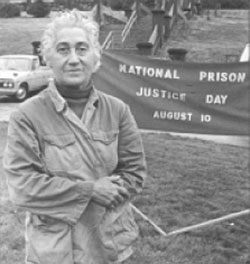
Claire CulhanePhoto Credit : prisonjustice.ca
Claire Culhane
Claire Culhane – an internationally recognized leader in the anti-war and prisoners’ rights movements – was one of the foremost political activists of her day.
Culhane was born in Montreal. Her parents, Rose and Abraham Eglin, were Russian Jewish immigrants. She had one older brother, Jack. From an early age, Culhane showed a passion for social justice and civil disobedience. In her youth, during the Depression, Culhane was part of the relief movement in Quebec. Later, as a young woman, she joined the Communist Party of Canada and supported an end to the Spanish Civil War. The RCMP file on her activism ultimately spanned almost 50 years.
In 1967, Culhane accepted a one-year government contract to work at a tuberculosis hospital in Quang Ngai City, Vietnam (near Saigon). She intended to use her training as a medical records librarian in Montreal to serve the hospital as an advisor and administrative assistant. She soon realized that the confidential record system she had helped to set up was being repeatedly compromised by the head of the Canadian medical aid team, who was passing along patient information to both the American Embassy and the CIA. She became disillusioned with Canada’s role in the war and left Vietnam in February of 1968, less than two weeks before the My Lai massacre.
Back in Canada, Culhane protested the war in numerous ways. She filed an official protest with the Canadian government, did a 10-day fast on Parliament Hill in Ottawa, chained herself to a gallery chair in the House of Commons, and camped out for 19 days in the cold with filmmaker Mike Rubbo to distribute anti-war pamphlets during their “enough/assez” campaign. She also wrote a book, Why is Canada in Vietnam? The Truth about our Foreign Aid, which helped galvanize the anti-war movement.
Beyond this, Culhane was best known for her work in support of prisoners’ rights; she did not believe in reforming prisons, but in dismantling them. In 1975, there was a hostage crisis at the Lakeside Regional Correction Centre for women, where Culhane volunteered as a women’s studies teacher. Three prisoners who were being sent back to solitary confinement took 15 people hostage, leading to a 41 hour standoff with prison officials; a young guard was accidentally killed by the guards when the emergency response team stormed the premises.
Culhane became a founding member of the Vancouver activist group Prisoners’ Rights Group and, in 1976, joined the newly formed Citizens Advisory Committee (CAC). With CAC, she helped to negotiate the end of the worst riot in 50 years, at BC Pen, but was subsequently barred from entering prisons for many years. She wrote two books about these experiences, Barred from Prison: A Personal Account and Still Barred from Prison: Social Injustice in Canada. Her activism included sit-ins at warden’s offices, picketing on Parliament Hill, hosting a cable TV show called Instead of Prisons, and writing and speaking extensively on the topic of prison as a form of social control.
A biography of Culhane, One Woman Army by Mick Lowe, was published in 1992.
-
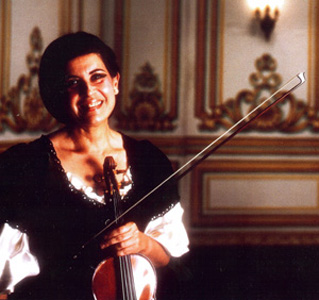
Yaëla Hertz.Photo Credit : Archives of Yaëla Hertz -
Photo Credit : Archives of Yaëla Hertz -
Yaëla Hertz at JuilliardPhoto Credit : Archives of Yaëla Hertz
Yaëla Hertz
Yaëla Hertz – a Sabra who settled in Quebec as a young woman – was integral to the history of classical music in Montreal as a consummate musician, revered teacher and mentor, and one of the first women to hold the position of concertmaster in any professional orchestra.
Hertz was born in Tel Aviv, in what was then Palestine. Her mother, Atara Glickson-Hertz, was concertmaster at the Palestine Opera, and was her daughter’s first violin teacher. During the Israeli War of Independence, Hertz served in the IDF, playing violin for the troops.
She participated in two violin competitions in her teens, at 16 in Geneva and at 19 in Prague, where she wore an Israeli uniform and won honours. She was then awarded a full scholarship to attend Juilliard. There, Hertz was introduced to Alexander Brott by her teacher, Misha Mischakoff, Toscanini’s concertmaster. At Brott’s invitation, she joined the McGill Chamber Orchestra first as a soloist and then as concertmaster; she held the latter position from 1959 through 2002.
Hertz was also a professor of violin, a soloist, a member of the Hertz Trio, a member of the Montreal Symphony Orchestra, and a violin coach with the National Youth Orchestra of Canada. She taught at McGill University, Vincent D’Indy, the Conservatoire du Quebec and KlezKanada. Hertz recorded with the McGill Chamber Orchestra; with CBC radio as a soloist; with the Montreal Trio with her brother, cellist Talmon Hertz , and violist Steve Kondaks; and with the Hertz Trio with Talmon and pianist Dale Bartlett.
During many of her concert tours, Hertz gave master classes in violin and chamber music, working with programs like the Musicians of Tomorrow – an intensive music program in northern Israel for talented children, founded by Maxim Vengerov and Anna Rosnovsky.
Hertz and her husband, Dr. Nathan Berkson, a Montreal surgeon, had three children.
-
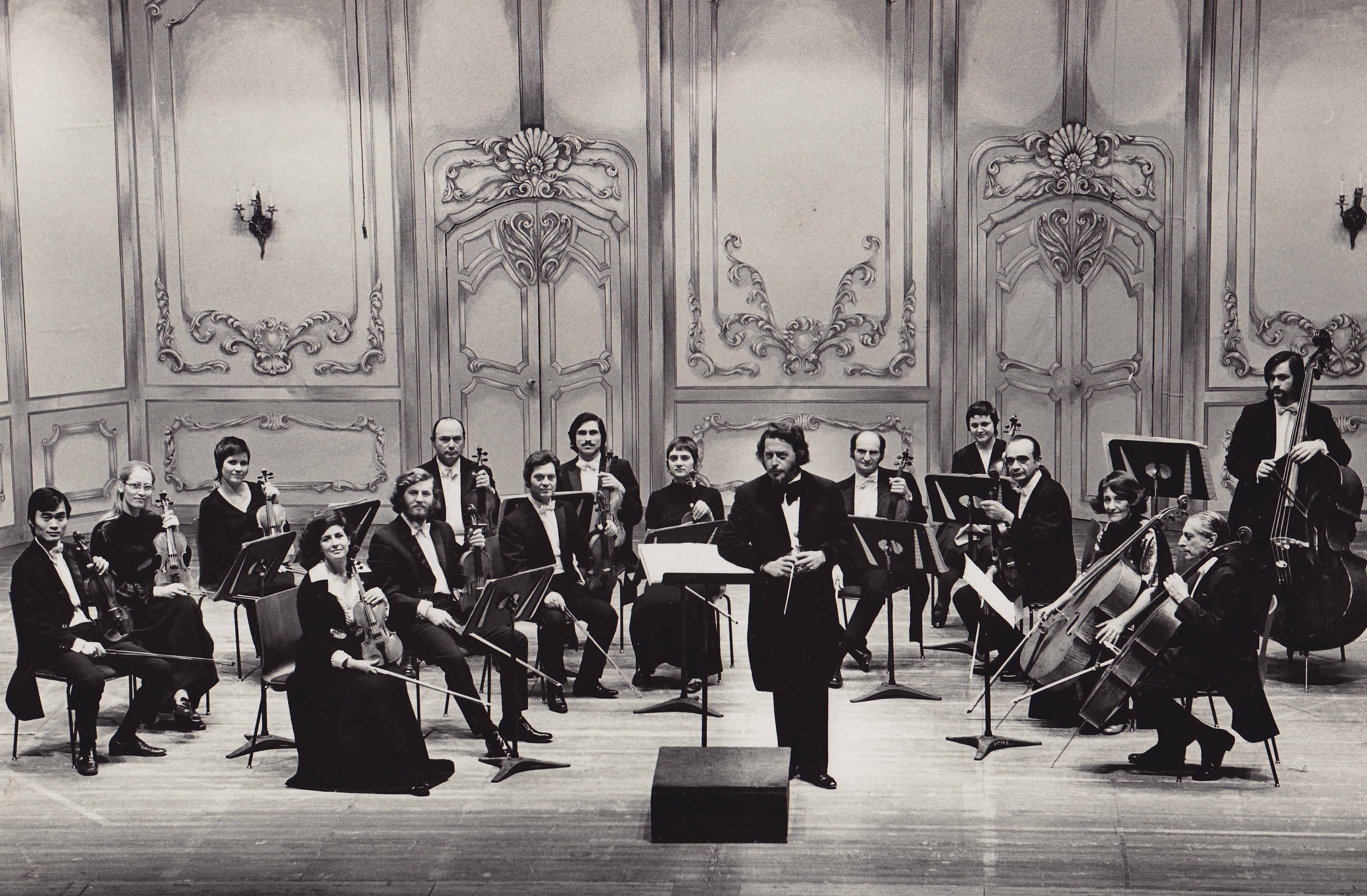
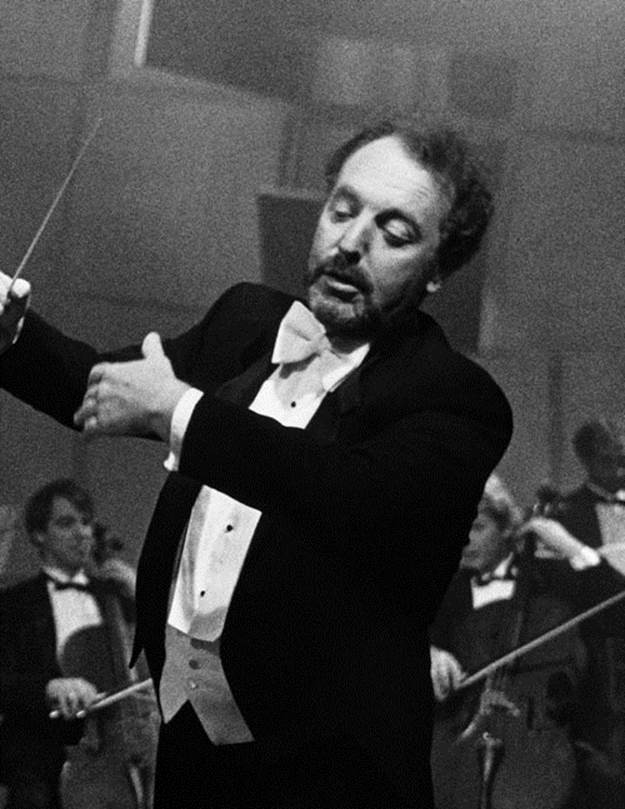
Yuli Turovsky leading the I Musici De Montreal Chamber (2000s).Photo Credit : I Musici de Montréal
Yuli Turovsky
Yuli Turovsky was an acclaimed Soviet-born Canadian cellist, conductor and music educator who founded and directed the I Musici de Montréal Chamber Orchestra.
Turovsky was born in Moscow, in the former Soviet Union. At seven, he began playing the cello at the Moscow Central Music School, and then attended the Moscow Conservatory (1957-1969). He became a rising star in the Soviet classical music scene, winning first prize in the USSR Cello Competition and second prize at the Prague Spring International Music Festival. He went on to become lead cello for the Moscow Chamber Orchestra.
In the 1970s, Turovsky and his family settled in Montreal. There, he founded the I Musici de Montréal Chamber Orchestra (1983), which became one of the best known classical ensembles in Canada. Turovsky’s wife, Eleanora, was principal violin of the string orchestra from its founding until 2011, and he directed and conducted it until his death in 2013, from Parkinson’s disease.
Over the course of his career, Turovsky produced over 30 recordings. He toured internationally as a soloist, with the Borodin Trio, and with his string orchestra. He also taught at the Quebec Music Conservatory in Montreal (1977- 1985) and at UQAM (1979-until the early 2010s).
Turovsky was named a Knight of the National Order of Quebec (2010) and an Officer of the Order of Canada (2012), and he received the 2012 lifetime achievement award from the Quebec Music Council (Prix Opus).
Learn more:
http://quebecscene.ca/fr/events/eventdetails.asp?eventid=200
http://snipview.com/q/soviet_emigrants_to_canada
http://imusici.com/en/hommage-a-yuli-turovsky/
https://en.wikipedia.org/wiki/Yuli_Turovsky
http://www.thecanadianencyclopedia.ca/en/article/yuli-turovsky-emc/
http://www.thestrad.com/cellist-and-conductor-yuli-turovsky-dies/
http://imusici.com/en/orchestre/l-orchestre-de-chambre/fondateur/
http://www.bach-cantatas.com/Bio/Turovsky-Yuli.htm
http://www.cbc.ca/news/entertainment/montreal-cellist-yuli-turovsky-dies-at-73-1.1409698
http://www.lapresse.ca/arts/musique/201301/15/01-4611522-deces-du-violoncelliste-et-chef-dorchestre-yuli-turovsky.php
-
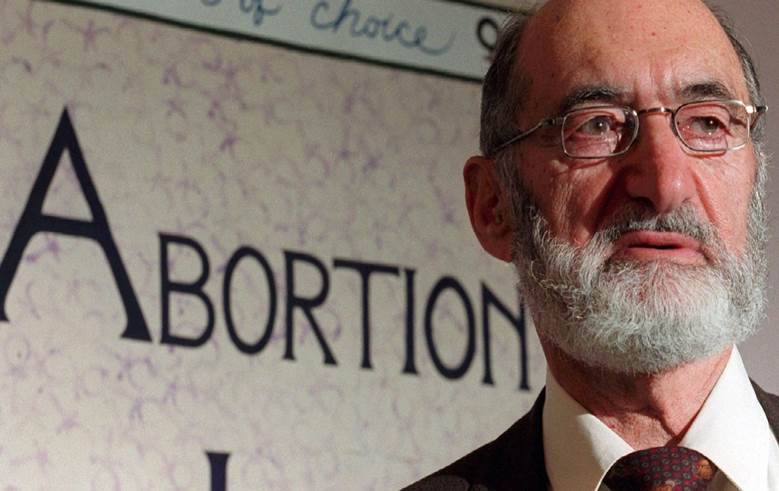
Dr. Henry Morgetaler speaks at press conference in Toronto in 1998 to mark the ten-year anniversary of the Supreme Court of Canada's decision to decriminalize abortion.Photo Credit : Canadian Press -
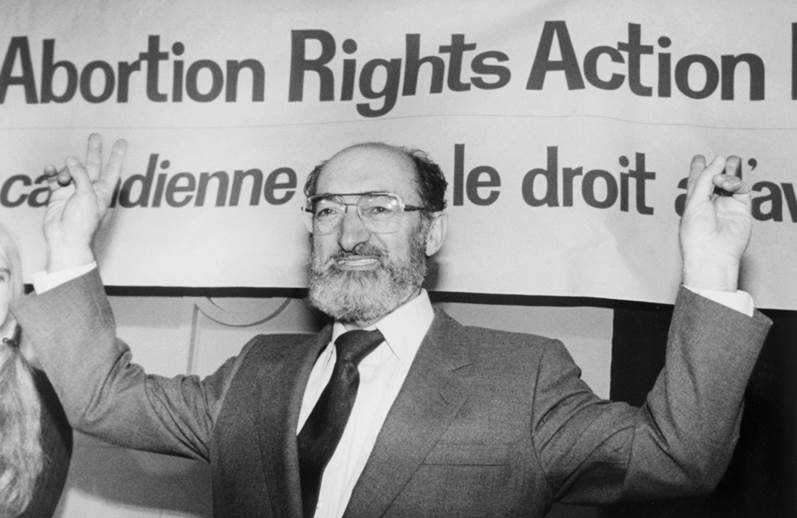
Dr. Henry Morgentaler raises his arms in victory at a news conference in Toronto, Ontario, Jan. 28, 1988.Photo Credit : Canadian Press
Henry Morgentaler
Henry Morgentaler was a Lodz-born physician, who held the Order of Canada for his fight for legalized abortion.
A survivor of the Lodz Ghetto and Dachau concentration camps, Morgentaler survived the war with his brother but lost both his parents to the Nazis. Morgentaler arrived in Montreal in 1950 with his writer wife, Chava Rosenfarb, to study medicine at the Université de Montréal.
In 1967, he delivered his famous brief to the House of Commons Welfare Committee stating that women in Canada should have the right to end their pregnancies without risking their lives, as heretofore, the only available abortions – illegal ones – were often risky. Realizing how great a need there was for safe abortions in Canada, Morgentaler founded his eponymously named Montreal Clinic in east-end Montreal in 1969, the first independent clinic to offer abortions to women in Canada.
Although a limited and specific number of abortions became legal in 1969, Morgentaler’s were not, since he did not demand medical prerequisites for his patients. His clinic was raided multiple times, and he was charged just as frequently. His legal battles were so lengthy and legendary – including multiple arrests, dozens of charges, a 10-month prison stint at Montreal’s Bordeaux jail during which he suffered a mild heart attack, and three jury acquittals in Quebec – that the Canadian Parliament enacted the Morgentaler Amendment, stating that no person can have a jury acquittal overturned by an Appeals court.
Morgentaler was raised within the social milieu of the Jewish Bund of prewar Poland, a secular, socialist and Yiddish cultural environment, which he credits with his commitment to human rights. He was a long-time member and president of the Canadian Humanist Association and its lifetime honorary president, and was named Humanist of the Year by the American Humanist Association in 1975.
Dogged by protests, death threats and violence over the decades, even his nomination to the Order of Canada in 2008 was controversial.
Learn more:
http://www.morgentaler25years.ca/about-henry-morgentaler/
https://www.youtube.com/watch?v=T7e0j7BFKoo
https://www.youtube.com/watch?v=QHAMael4uGY
http://o.canada.com/news/new-brunswick-pro-choice-group-raises-100000-to-save-morgentaler-clinic
http://www.ctvnews.ca/health/health-headlines/controversial-abortion-crusader-dr-henry-morgentaler-dies-at-90-1.1302143
https://www.thestar.com/news/canada/2013/05/29/henry_morgentaler_abortion_crusader_dead_at_90.html
http://news.nationalpost.com/news/canada/henry-morgentaler-hailed-as-a-true-canadian-hero-and-the-cause-of-unbelievable-damage
http://thechronicleherald.ca/canada/1131986-in-pictures-dr-henry-morgentaler-over-the-years