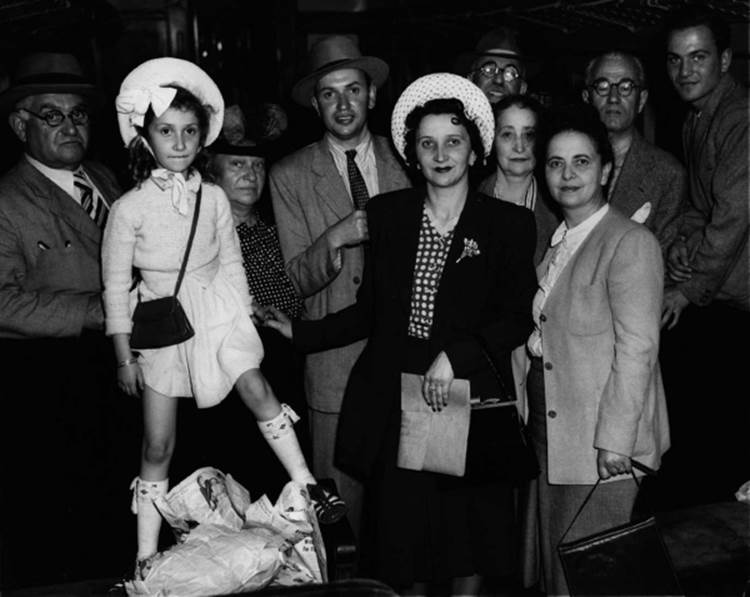
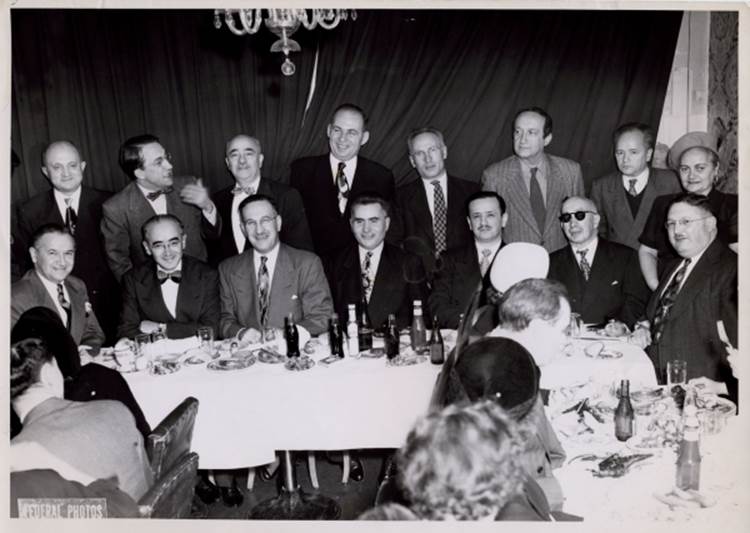
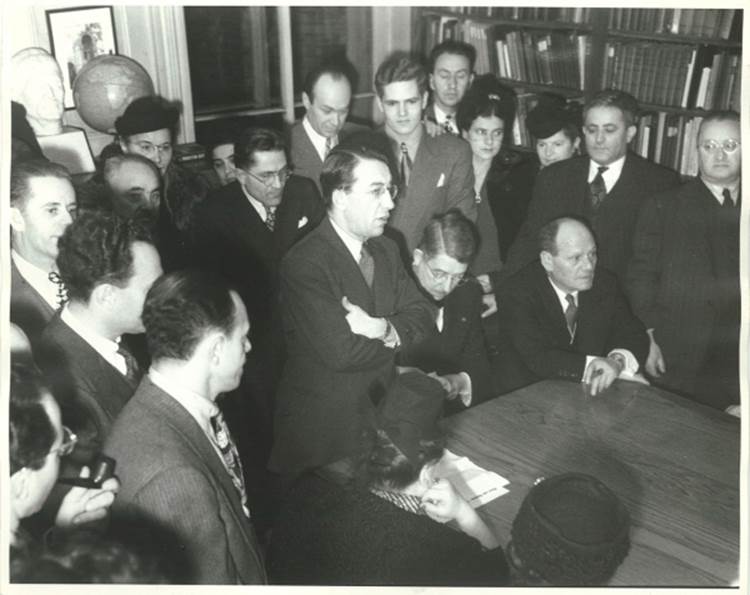
Jewish immigrants arriving in Montreal after WWII. Many of these immigrants were brought to Canada through the initiative of the Tailors Project.
Photo Credit : Alex Dworkin Canadian Jewish Archives
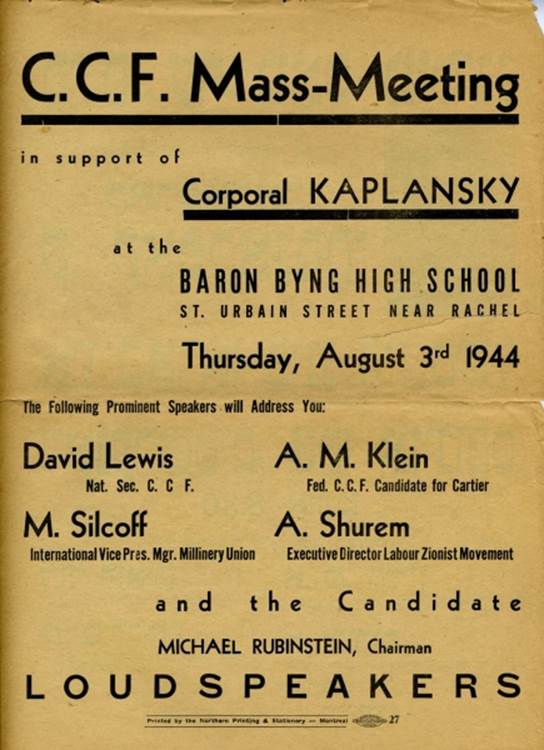
From 1943 to 1946 Kalmen Kaplansky fought for the Canadian army. This flyer advertises a mass meeting in his honour sponsored by the political party he was a member of, the C.C.F., (predecessor to the N.D.P), in Aug. 1944.
Photo Credit : Jewish Public Library - Archives
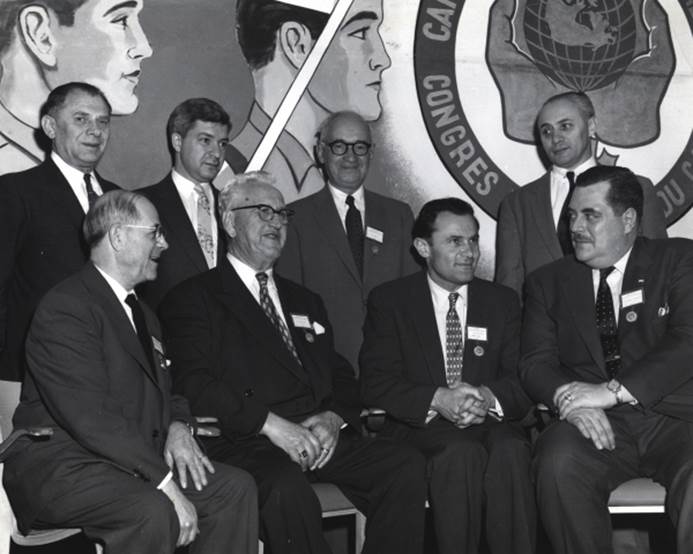
Kalman Kaplansky (top row, second from left), and other leaders at Canadian Labour Congress, ca. 1950s.
Photo Credit : Alex Dworkin Canadian Jewish Archives
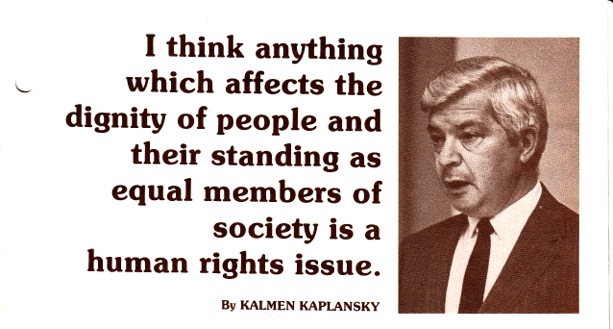
Kalmen Kaplansky
Kalman Kaplansky is known as the zayde (grandfather) of the human rights movement in Canada.
Kaplansky was born in Bialystok, in present-day Poland. In 1929, following his high school graduation, he immigrated to Canada by himself. There, he intended to enroll at McGill University, but his efforts were thwarted by the institution’s rigid anti-Semitic quota system. Instead, Kaplansky became a tradesman, working as a typesetter and linotype operator from 1932-43. During the Great Depression, he quickly rose to prominence in the Labour movement as a trade union executive. He was a delegate of the Montreal Typographical Union 176 to the Trades and Labour Congress of Canada, and then to the merged Canadian Labour Congress. To support the war effort, he enlisted as a sergeant in the Canadian Army from 1943-46.
In 1939, Kaplansky helped to form the Jewish Labour Committee (JLC) in Canada – which was an offshoot of the American Labour organization, founded six years earlier. He served as the JLC’s secretary from 1936-38, and was its national director from 1946-57. Sitting at the organization’s helm, he steered the JLC movement towards a human rights focus, not just directed at combating anti-Semitism but at discrimination against all racial and ethnic minorities, including Black Canadians, French Canadians and First Nations. His efforts were instrumental in passing the Ontario Fair Employment Practices Act of 1951, which banned racial discrimination in hiring, and had a positive ripple effect all across Canada. He went on to play an important role in the International Labour Organization and the Canadian Labour Congress, as well. He also had close ties to the Cooperative Commonwealth Federation (CCF) – the NDP’s predecessor – and was a candidate in two elections: provincially in 1944 and federally in 1950.
In 1947, Kaplansky, along with Moishe Lewis, famously spearheaded the “Tailor’s Project” – a joint effort of the JLC and the Workmen’s Circle to circumvent Canada’s stringent quota system for Jewish immigration and bring in hundreds of refugees from DP camps as garment industry workers after WWII. He was later awarded the Order of Canada.
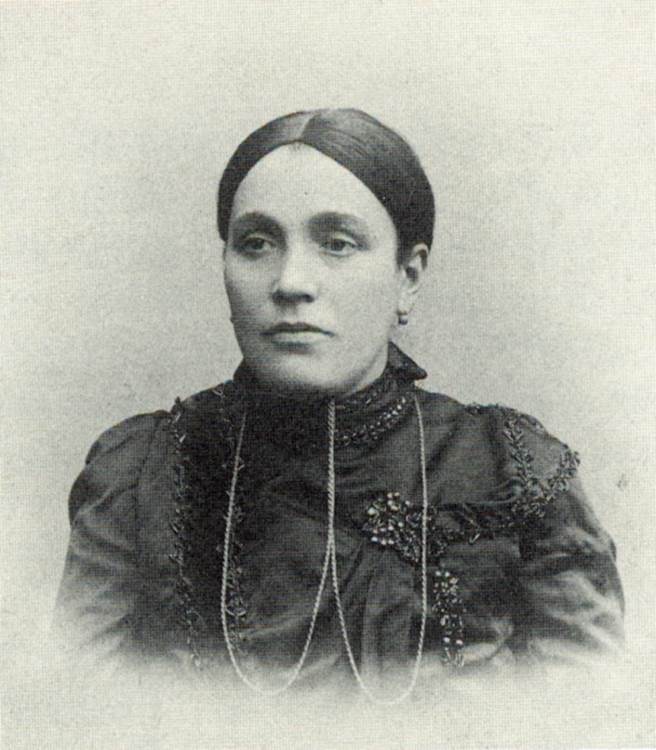
A portrait circa 1910 of Taube Kaplan – reproduced from the Montreal Clinical Society history souvenir book.
Photo Credit : Alex Dworkin Canadian Jewish Archives
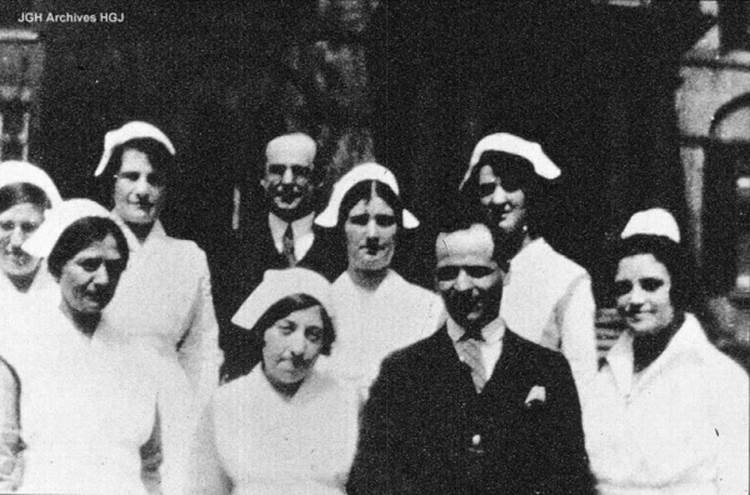
Nurses and doctors outside of the Hebrew Maternity Hospital in 1925 which offered obstetrics to Jewish and non-Jewish women. It was a precursor, along with the Herzl Dispensary, to the Jewish General Hospital and was founded in large part through the efforts of Taube Kaplan. It was located on Cadieux Street (now de Bullion St.).
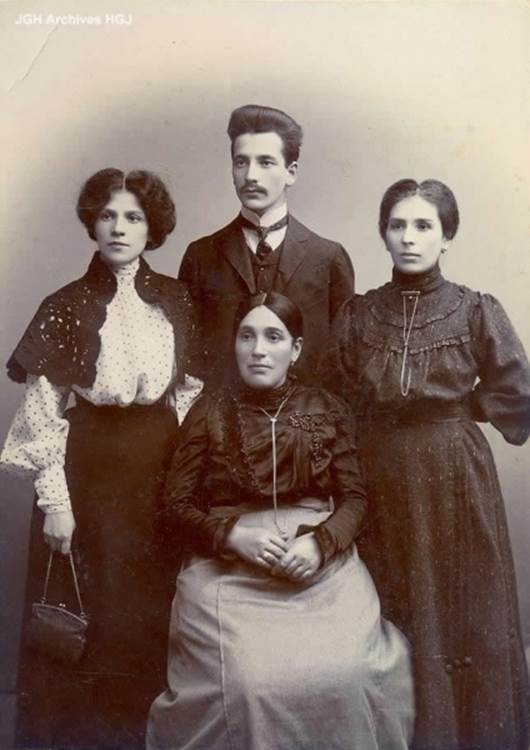
Taube Kaplan pictured with three of her children in Vilnius. From left to right: Mrs. Rachel Bach, Mr. Ben Wiseman, Mrs. Anna Arons. Seated: Mrs. Taube Kaplan.
At a time when Montreal's infant mortality rate was one of the highest in the world, Taube Kaplan went door to door to collect the funds necessary for the creation of the first Jewish maternity hospital in Montreal.
In the 1910s, Montreal’s infant mortality rate was among the highest in the world: more than one in five children died before their first birthday. The situation was especially dire in the impoverished neighbourhoods that were home to many of the city’s Jewish immigrants. In 1914, Kaplan proposed the creation of a hospital providing prenatal and postpartum care for young Jewish women. In response to the massive immigration of mostly destitute Eastern European Jews, Kaplan sought to provide services for mothers otherwise unable to afford it. The hospital was created specifically for Jewish women, and served kosher food.
Kaplan achieved a feat that would be almost unthinkable today, canvassing door-to-door for years to raise funds for the construction of the Montreal Hebrew Maternity Hospital. The individual donations she collected financed the purchase of a building on Cadieux Street (today Rue De Bullion), to be turned into a hospital. With the support of several influential individuals, among them a group of physicians headed by Dr. J. R. Goodall, the project was completed in 1916.
Kaplan was a pioneer in the area of Jewish hospital services at a time when none were available in Montreal. Her actions led to the creation of a precursor institution to the Jewish General Hospital. She also played an important role with regard to the position of Jewish women in society. While women in general were only just beginning to become involved in public matters and institutions, such participation was even less common in Kaplan’s Orthodox community. A woman of modest origins who taught Hebrew and religion several hours a week to supplement her husband’s meagre income, Kaplan consistently refused recognition for her efforts. This led her to decline the honour of having a ward named after her in the future Montreal Jewish General Hospital.
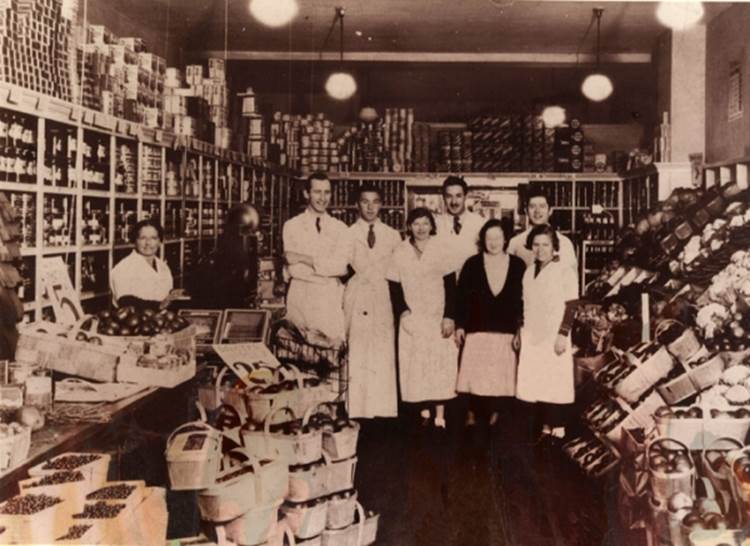
Early photograph of the interior of Steinberg grocery store. Group portrait with employees, Ida Steinberg (behind cash). ca. 1920s.
Photo Credit : Jewish Public Library - Archives
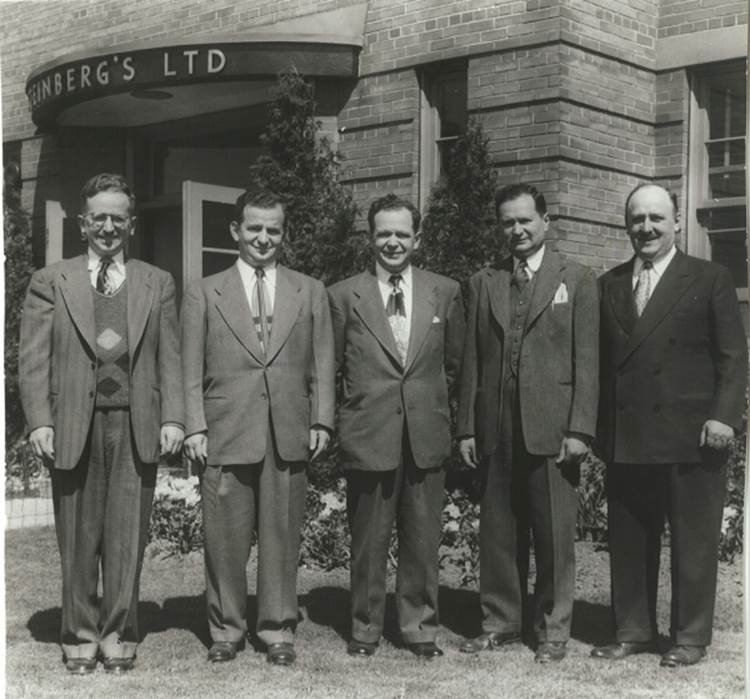
Exterior of Steinberg's Limited. Group Portrait, Nathan Steinberg, Jack Steinberg, Sam Steinberg, Max Steinberg, Morris Steinberg. ca. 1950s.
Photo Credit : Jewish Public Library - Archives
Steinberg’s
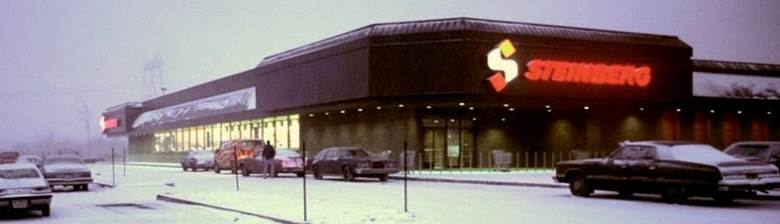
Samuel Steinberg was a Hungarian-born Canadian businessman and philanthropist whose drive and vision transformed his mother’s unassuming grocery store, Steinberg’s Supermarket, into the largest grocery chain in Quebec.
Steinberg moved to Canada as a child and worked, along with his four brothers, at Steinberg’s Supermarket. Through mass merchandising, industrial mechanization of food production and employee management, he transformed the world of food retailing in Quebec. And by the late 1950s, his stores had expanded into Ontario. For several decades, Steinberg’s was the largest supermarket chain in all of Quebec, running in close competition with stores like Provigo and Metro. Steinberg was also a director of Ivanhoe and Pharmaprix.
Steinberg was one of the first employers to implement mandatory bilingualism (English and French) for all his employees. As result, the supermarket became a meeting point for the Montreal Jewish community and their Quebecois neighbours. Among Francophones, “Je fais mon Steinberg” (“I’m doing my Steinberg’s”), came to be synonymous with the act of grocery shopping, regardless of the supermarket chain. In 1974, Steinberg became a local celebrity, when he was the subject of the National Film Board of Canada documentary, After Mr. Sam. At the time of his death, the company was annually grossing over $1 billion, was the largest supermarket chain in Quebec, and was completely family-owned.
Steinberg and his wife Helen (née Roth) were generous donors who funded a number of philanthropic causes including The Pavilion of Judaism at Expo 67, the Helen and Sam Steinberg Foundation’s Geriatric Day Hospital, and the Sam Steinberg Award for Young Jewish Entrepreneur of the Year, awarded by the Jewish Chamber of Commerce of Montreal. Steinberg also served as Chairman of the Board of Governors of the Canada-Israel Chamber of Commerce, as a member of the Canada Council and as National Director and Co‑Chairman of the Canadian Council of Christians and Jews. For his contributions to Canadian society and its economy, Steinberg was made an Officer of the Order of Canada and inducted into the Canadian Business Hall of Fame.
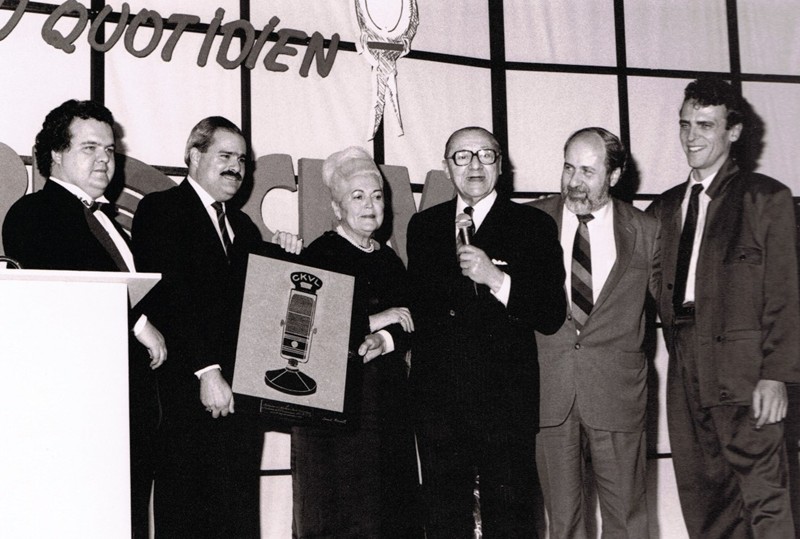
Jack Tietolman was a community-oriented Montrealer who worked in broadcasting and co-founded the French-language radio station CKVL.
Tietolman’s broadcasting career spanned 40 years. He created the General Broadcasting Company in 1934 and, in 1946, he and Corey Thomson co-founded the bilingual (but predominantly French-language) radio station CKVL. CKVL, which stood for “Canadian Kilocycle Verdun Lakeshore,” aired a variety of programs, including many radio dramas. Tietolman was one of the first broadcasters in Canada to hire female announcers; one of the most popular was Reine Charrier (aka “Madame X”), who hosted Quebec’s first open-line talk show, starting in 1959.
Tietolman was president and principal shareholder of several companies, including Verdun Radio Centre Inc., Radiomonde Limitée, Radio Futura Limited, Radio and Television Sales Inc., Verdun Import Sales Corporation, all of which were connected to promoting radio stations.
Tietolman was an active member of many community organizations. He was a director of Notre-Dame Hospital, the Douglas Hospital, the Montreal YMCA, the Montreal YMHA, the Canadian Cancer Society and the Jewish Hospital of Hope. He was President of the Montreal West End Lodge of B’nai Brith. He was also a member of the Canadian Council of Christians and Jews, the Montreal Board of Trade, the Canadian Chamber of Commerce and the Quebec Chamber of Commerce.
Tietolman was awarded L’Ordre de mérite de la culture française, as well as the Outstanding Citizen Award from the Montreal Citizenship Council.
Business and Philanthropy
Share
Jeff Segel, Alan, Martin and Jeffrey Schwartz.
Photo Credit : Jewish General Hospital
Photo Credit : Dorel Industries
Dorel Industries
If you’ve ever pushed a baby stroller or buckled a child’s car seat, ridden a bike down a street or furnished a living room, there’s a pretty good chance you’ve enjoyed a Dorel product along the way.
Based in Montreal – with Martin Schwartz, Alan Schwartz, Jeffrey Schwartz and Jeff Segel at the helm – Dorel Industries currently boasts annual sales of over US $2.7 billion, employing over 10,000 people in some 25 countries worldwide.
Dorel is an epic success story that started back in 1962, when Leo Schwartz began selling juvenile products in Montreal under the Dorel name. A few years later, in 1969, Martin Schwartz, Jeff Segel, Jeffrey Schwartz and Alan Schwartz founded a company selling ready-to-assemble furniture to Canadian customers. And so, Dorel Industries was born.
Today, the company operates via three core divisions: Juvenile, Sports and Home Furnishings. Its Juvenile division is known throughout the world for its safety, comfort and innovative design, and comprises powerful brands including Safety 1st, Quinny, Cosco, Mother’s Choice and Maxi-Cosi.
Dorel Sports has turned the cycling world on its ear via iconic brands like Cannondale, Schwinn, GT, Mongoose and Sugoi. Lastly, Dorel Home Furnishings boasts an incredible brand roster such as Ameriwood Home, Dorel Living, Signature Sleep and DHP.
Dorel Industries’ strength is based on the diversity, superior quality and innovative style of its brands and products. But just as important is Dorel’s profound commitment to giving back to the community. In fact, Dorel has made major gifts to Federation CJA, to changing the face of Jewish camping, Yaldei school and the Jewish General Hospital, even donating vital products to needy families affected by Hurricane Katrina.
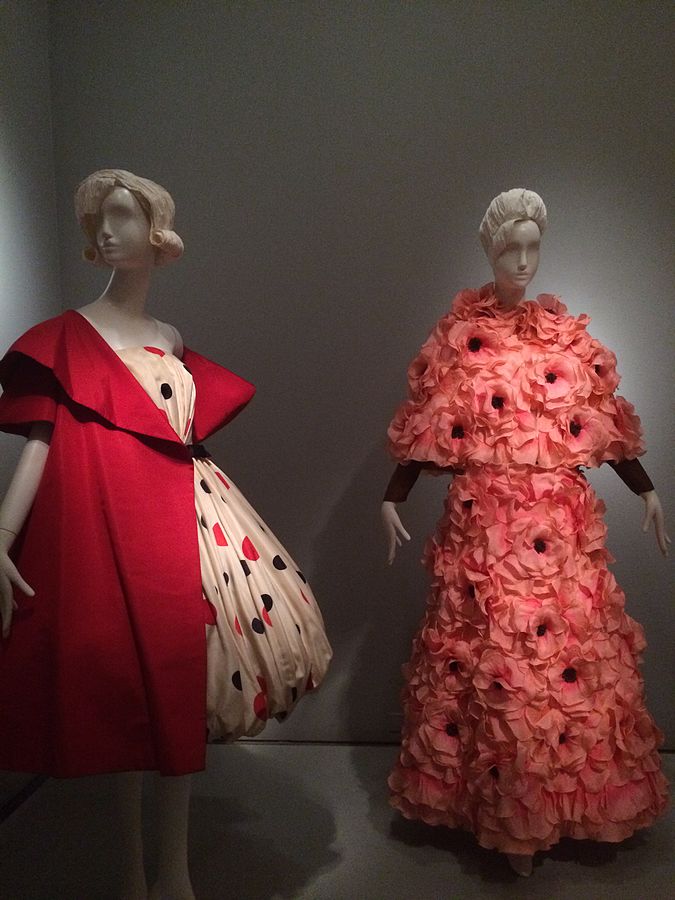
Photo Credit : Brooklyn Museum Costume Collection at The Metropolitan Museum of Art
1930 - 2015
Arnold Scaasi
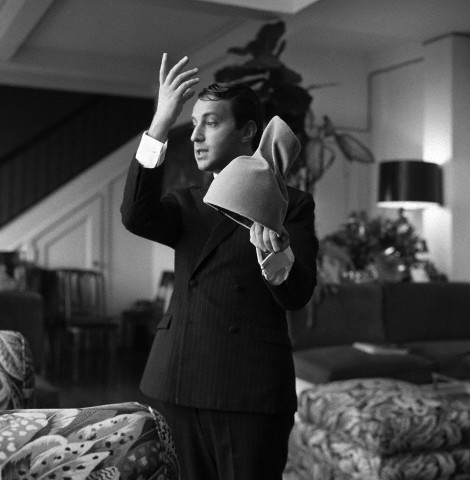
Arnold Scaasi was a legendary Montreal-born fashion designer who created iconic gowns for first ladies, movie stars and socialites, including Barbara Streisand, Hillary Clinton, Princess Yasmin Aga Khan and Elizabeth Taylor.
Scaasi was born Arnold Isaacs, to an immigrant Jewish family in Montreal. He was introduced to fashion at a young age because his father was a furrier. His formal study of fashion took place first at Montreal’s Cotnoir-Capponi School of Design and then at the Syndical Chamber for Haute Couture in Paris. Scaasi moved to New York City soon afterward, where he worked with designer Charles James.
He was encouraged to change his name (Scaasi is Isaacs backward) by interior designer Robert Denning (originally Robert Dennis Besser), who said it would give him an Italian flair. With this new moniker, Scaasi quickly rose to prominence as a fashion designer, one of his dresses making the cover of Vogue in 1955. In 1964, he opened his own couture house in New York City, attracting socialites and celebrities. His signature looks were cocktail dresses (incorporating fur, feathers, sequins, embroidery), tailored suits and glamorous evening wear. When Barbara Streisand wore Scaasi’s sheer, sequined pant suit to the Academy Awards the year she won for Funny Girl, the designer was propelled to international stardom.
Scaasi’s most memorable designs are held in museum collections and couture houses around the world, including the Smithsonian Institution and the New York Historical Society. They have also been featured in retrospectives at venues including Kent State University, Ohio University and the Fashion Institute of Technology. He authored two books: Scaasi: A Cut Above and Women I Have Dressed (and Undressed!).
In 1996, Scaasi received the Council of Fashion Designers of America Lifetime Achievement Award.
Montreal native Moses “Moe” Nadler was the founder and majority owner of the Canadian Lady Corset Company, which developed the iconic push-up underwire brassiere, Wonderbra.
Nadler opened the Canadian Lady Corset Company, a small sewing shop in Montreal, in 1939. Between 1939 and 1955, the lingerie company produced girdles, swimsuits, slips, panties and bras. By the 60s, the entire company had been rebranded “Wonderbra, the company.” And by the mid-60s, it was exporting and licensing the Wonderbra line to Western Europe, Israel, Australia, South Africa and the West Indies.
Israel Pilot, the New Yorker from whom Nadler initially licensed the “Wonder-Bra trademark” and diagonal slash patent, cut the revolutionary bra cup on the bias to give women added comfort and freedom of movement in a time when elastics weren’t available for clothing, due to WWII rationing. The American Wonder-Bra was trademarked in 1955. Nadler subsequently bought the rights, developing and redesigning the brand as Wonderbra in Canada.
The Wonderbra’s development coincided with the Feminist movement. While women were still wearing girdles in the late 50s and early 60s, the sexual revolution caused a seismic shift in women’s fashion. Hemlines rose and highly structured undergarments were rendered obsolete. The Wonderbra – created by Quebec designer Louise Poirier, under Nadler’s direction – was made to fit a confident modern woman’s lifestyle.
The 1963 Dream Lift Model 1300, which is nearly identical to today’s Wonderbra, came to define the company. The plunge push-up bra was one of the best-selling styles in Canada, and in the 90s, it became an international sensation. Wonderbra was already a $27-million business in the 70s; by 1996, the 1300 design had broken the Guinness Book of World Record in sales.
Arts & Culture
Share
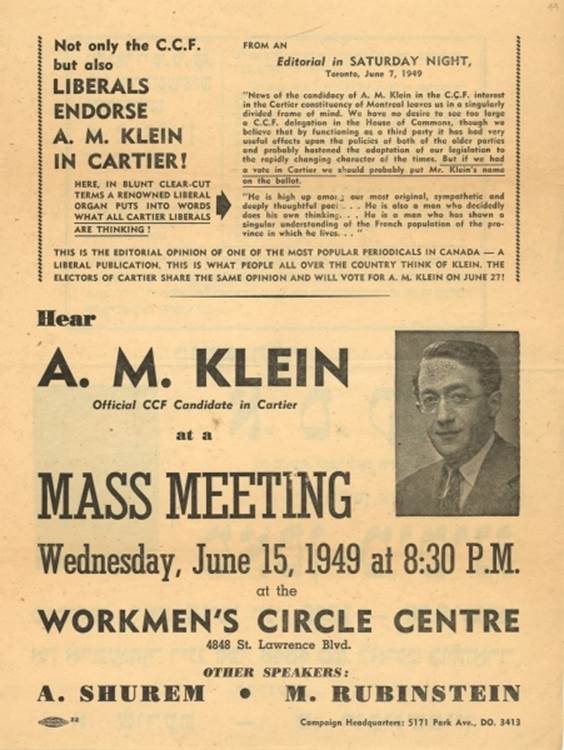
Flyer for a mass meeting supporting A. M. Klein's federal election campaign, at the Workmen's Circle Centre, June 15, 1949
Photo Credit : Alex Dworkin Canadian Jewish Archives
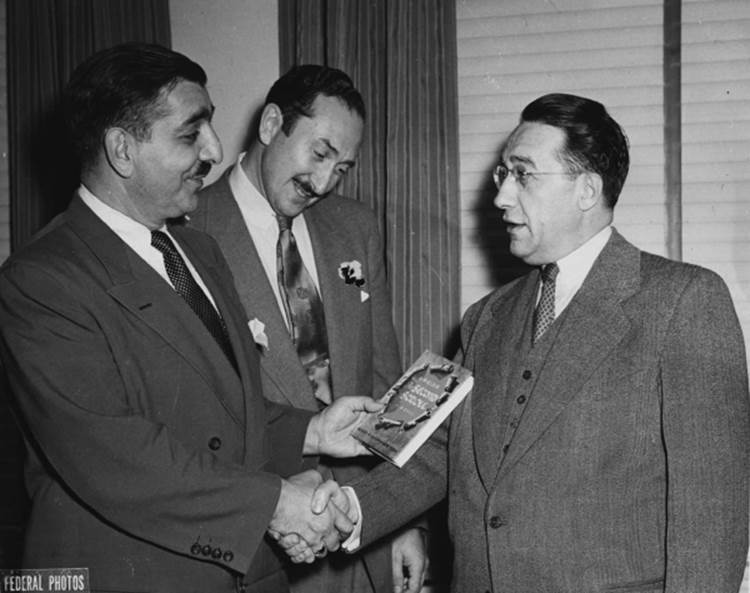
A. M. Klein (right) presenting Monroe Abbey (left) a copy of his book, The Second Scroll, ca. 1951.
Photo Credit : Alex Dworkin Canadian Jewish Archives
A meeting of many Jewish literary figures from Montreal who wrote in Yiddish or English (or both) including Israel Rabinovitch (Keneder Adler editor), A. M. Klein (poet), Mordechai Ginzburg (Yiddish journalist) and Jacob Isaac Segal (journalist and Yiddish poet), ca. 1950s.
Photo Credit : Jewish Public Library - Archives
Group portrait, including Maurice Hartt (at that time a Member of the Legislative Assembly of Quebec, later a federal MP), Pierre Van Paasen, Michael Becker, and A. M. Klein, upon the occasion of the visit of Pierre Van Paasen (a Dutch-Canadian journalist who supported Zionism) to the Jewish Public Library, November 25, 1945. Standing centre is A. M. Klein
Photo Credit : Jewish Public Library - Archives
1909 - 1972
A. M. Klein
A. M. Klein was a leading Canadian poet (as well as journalist, novelist, short story writer and lawyer), in whose memory the A.M. Klein Prize for Poetry was created by the Quebec Writers' Federation.
Born in Ratno, Ukraine in 1909, Klein immigrated to Montreal with his family in 1910. His Orthodox father wanted his son to become a rabbi and greatly influenced Klein’s early formation in rabbinic literature. Klein attended Baron Byng High School, and then McGill, where he studied political science, classics and economics, befriending a circle of poets and critics. There, he co-founded the McGilliad literary journal in 1930.
After completing his law degree at l’Université de Montréal, he joined a firm, even as his interest in literature grew. He wrote many poems in the 1920s and 30s on Jewish themes. Fluent in French, Klein understood the challenges and nuances of French Canadian politics, which made him a unique figure in the English-speaking Jewish community, as well as in most of English Canada. In 1948, Klein published The Rocking Chair, a series of poems about Quebec’s Francophone culture, using Montreal locations as sources of inspiration and establishing parallels between French Canadian and Jewish culture. He respected the Quebecois concern over culture, and opened up French Canada to many Anglophones through his poetry and writings. This collection won him a Governor General’s Award.
In 1949, Klein travelled to the newly established nation of Israel, as well as to Europe and Morocco. Articles about his experiences, entitled Notebook of a Journey, were published in the Canadian Jewish Chronicle, and went on to influence his only novel, The Second Scroll. Published in 1951, the book challenged the accepted boundaries of the Canadian novel, dealing with autobiographical themes as well as the Holocaust and the founding of Israel.
Klein was also an active member of the Montreal Jewish community. He served as editor of the Canadian Jewish Chronicle from 1932 until 1955 and was a consultant and speechwriter to Samuel Bronfman. In 1949, Klein ran unsuccessfully for the Canadian Parliament as a representative of the Co-operative Commonwealth Federation (the forerunner of the NDP). In 1956, he was awarded the Lorne Pierce Medal by the Royal Society of Canada. Despite the success of his writing, Klein suffered a nervous breakdown, ceased writing, and withdrew from public life by 1955.